A comparison between the Swiss and European WEEE recycling systems
Switzerland isn’t part of the European Union and, despite great similarities with the European framework, the country has its own legal, institutional and technical system for the disposal of waste electrical and electronic equipment (WEEE). This specific framework has led Switzerland to develop its own technical requirements and methodology for audits, as well as for conducting and evaluating batch tests. Certain methodological choices affect the calculated and published recycling rates, which are therefore not directly comparable with European rates.
Background
Although Swiss environmental legislation is largely based on European law and operational practices are similar, Switzerland has its own legal, institutional and technical framework for the disposal of waste from electrical and electronic equipment (WEEE). These specific characteristics have a direct impact on the organisation of recycling, the requirements placed on stakeholders in the recycling chain and consequently the calculated and published recycling rates.
As in most European Union countries, WEEE recycling is funded by manufacturers and importers. However, the legal and institutional framework for this funding differs significantly between Switzerland and the EU Member States, affecting how requirements are established, monitored and implemented.
Organisation of the European system and legal basis
Within the European Union, the WEEE Directive (2012/19/EU) forms the key legal basis for the disposal of WEEE. It requires Member States to introduce an Extended Producer Responsibility (EPR) system, under which manufacturers and importers must finance the collection, treatment and recycling of WEEE. This system is similar to the one used in Switzerland for material flows such as glass or batteries, where take-back and the financing of recycling are required by law and overseen by government authorities. The Member States implement this obligation in national legislation. In most countries, operational implementation is accomplished through officially recognised or approved take-back systems that organise the management of material flows and provide financial support for recycling. However, the practical arrangements vary from country to country; in particular, direct payments to recycling companies by take-back-systems are not systematic.
Organisation of the Swiss system and legal basis
In Switzerland, the disposal of WEEE is governed by the Ordinance on the Return, Taking Back and Disposal of Electrical and Electronic Equipment (ORDEE), which forms the central legal basis of the system. ORDEE sets out the general principles for environmentally sound take-back, treatment and disposal, explicitly addressing the issue of financing by providing for the possibility of advance recycling fees. Within this framework, WEEE recycling is organised by SENS eRecycling and Swico Recycling, both of them are private non-profit organisations. Funding is based on an advance t recycling fee borne by consumers and paid to the take-back-systems by manufacturers and importers; the cost is usually passed on to consumers by retailers at the point of sale. This charge is not a fee imposed directly by law but implemented by the take-back-systems within a contractual framework.
The technical, organisational and environmental requirements for recycling facilities are defined in the contracts between the take-back-systems and the recycling facilities, as well as in the take-back-systems technical guidelines. Compliance is verified by independent conformity assessment bodies, namely auditors appointed by the Technical Commission of SENS eRecycling and Swico Recycling.
Institutional differences between Switzerland and the European Union
The primary difference between the Swiss and EU systems lies in their institutional foundations. In the European Union, targets for collection, recycling and recovery are enshrined in legislation and subject to regulatory oversight at a national level. In Switzerland, the system is based on a combination of a legal framework setting out principles (ORDEE), interpretative implementation guidelines and contractual requirements established by the schemes.
The ORDEE implementation guidelines clarify how the authorities and industry stakeholders are expected to interpret the rules. They are not legally enforceable, but are a recognised tool for ensuring that the regulation is applied consistently by the cantons and the relevant stakeholders. Detailed management of recycling performance and technical oversight are largely the responsibility of the recycling systems SENS eRecycling and Swico Recycling, whilst the cantons are primarily responsible for general environmental aspects, such as facilities, emissions, storage and hazardous waste.
The European technical framework
From a technical perspective, the treatment of waste electrical and electronic equipment (WEEE) in Europe is now based on the CENELEC EN 50625 series of standards. The technical and organisational requirements applicable to recyclers were previously based on the WEEELABEX Standard for Treatment and were replaced by the EN 50625 series upon its publication.
At the European Union level, the WEEE Directive does not prescribe a single technical audit or certification scheme for recyclers. The main certification scheme implemented in Europe is WEEELABEX. The application of the EN 50625 standards and the audit schemes derived from WEEELABEX depends on national legislation and the specific requirements of the respective take-back systems1.
Swiss technical guidelines
In Switzerland, the contracts with SENS eRecycling and Swico Recycling also refer to the EN 50625 standards. However, these are supplemented by the SENS and Swico technical regulations for the SN EN 50625 series of standards (Supplementary Technical Regulations, eTV), which clarify and tighten certain requirements.
Audits are organised by independent auditors commissioned by the SENS eRecycling and Swico Recycling take-back systems. These audits are a prerequisite for the payment of financial contributions to the recycling companies. The audit methodology is based on the European system, but the protocols are specific to Switzerland and are not subject to a harmonised accreditation system at a European level.
Additional technical requirements in Switzerland
The most significant changes introduced or clarified in the Swiss technical guidelines include:
- Target values for recycling and recovery rates: the Swiss rates are defined as guidelines rather than strict limits. When evaluating a batch trial, the focus is not only on achieving the recycling rate, but also on the quality of the recycling process and the analysis of recyclable material losses.
- Consideration of pollutants: the mass fractions of polychlorinated biphenyls (PCBs) and, where applicable, other pollutants in the initial fractions are expressed as a percentage of the total input mass. The assessment is therefore not limited to the conformity of specific fractions, but examines the total pollutant load generated during treatment in order to evaluate the effectiveness of the cleaning and separation processes.
- Specific requirements for certain device categories: specific requirements are defined for certain categories, particularly for lamps, for which Swiss technical guidelines specify fixed threshold values for mercury in glass and metal fractions, whilst CENELEC standards focus primarily on pollutant removal requirements and processes.
Additional traceability requirements in Switzerland
In addition, Switzerland has strict requirements regarding the traceability and reporting of material flows. As in the EU, batch test results are entered into the European RepTool software. Unlike most European countries, where RepTool is also used for annual material flows, Swiss recycling companies report all their material flows using the national WEEE flow software.
This enables detailed tracking of incoming and outgoing material flows, as well as inventory. The data is consolidated across companies, with an outgoing flow at one entity having to correspond to an incoming flow at the next. This level of detail and consistency is not usually required at a European level.
Targets for recycling and recovery rates
In Switzerland, the recycling targets and rates set out in the ORDEE are not directly binding. These are defined in detail in the ORDEE implementation guidelines and specified for affiliated recycling companies in the technical guidelines and contractual requirements of SENS eRecycling and Swico Recycling. In the European Union, recycling and recovery rates are directly set out in the WEEE Directive and transposed into national law.
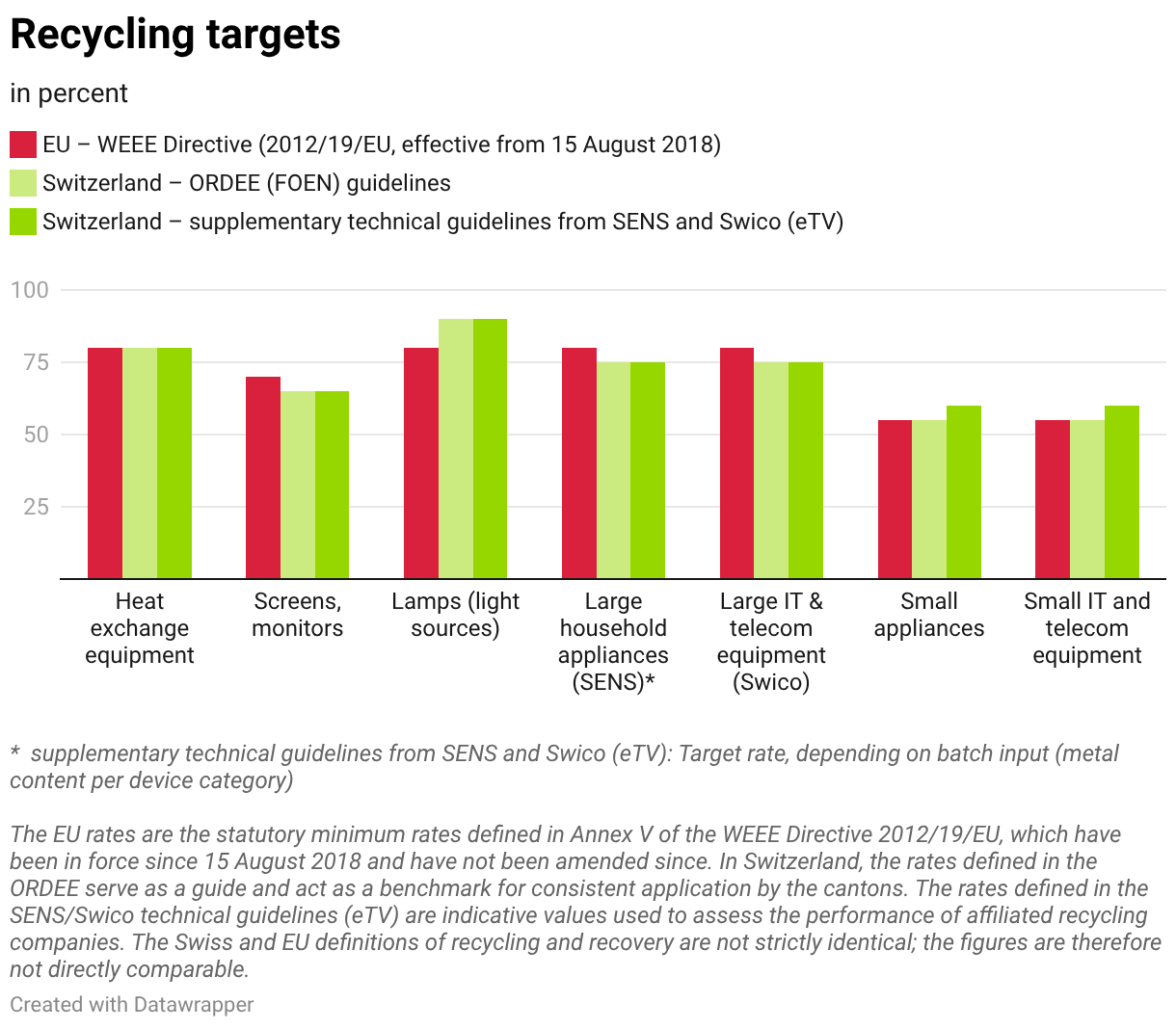
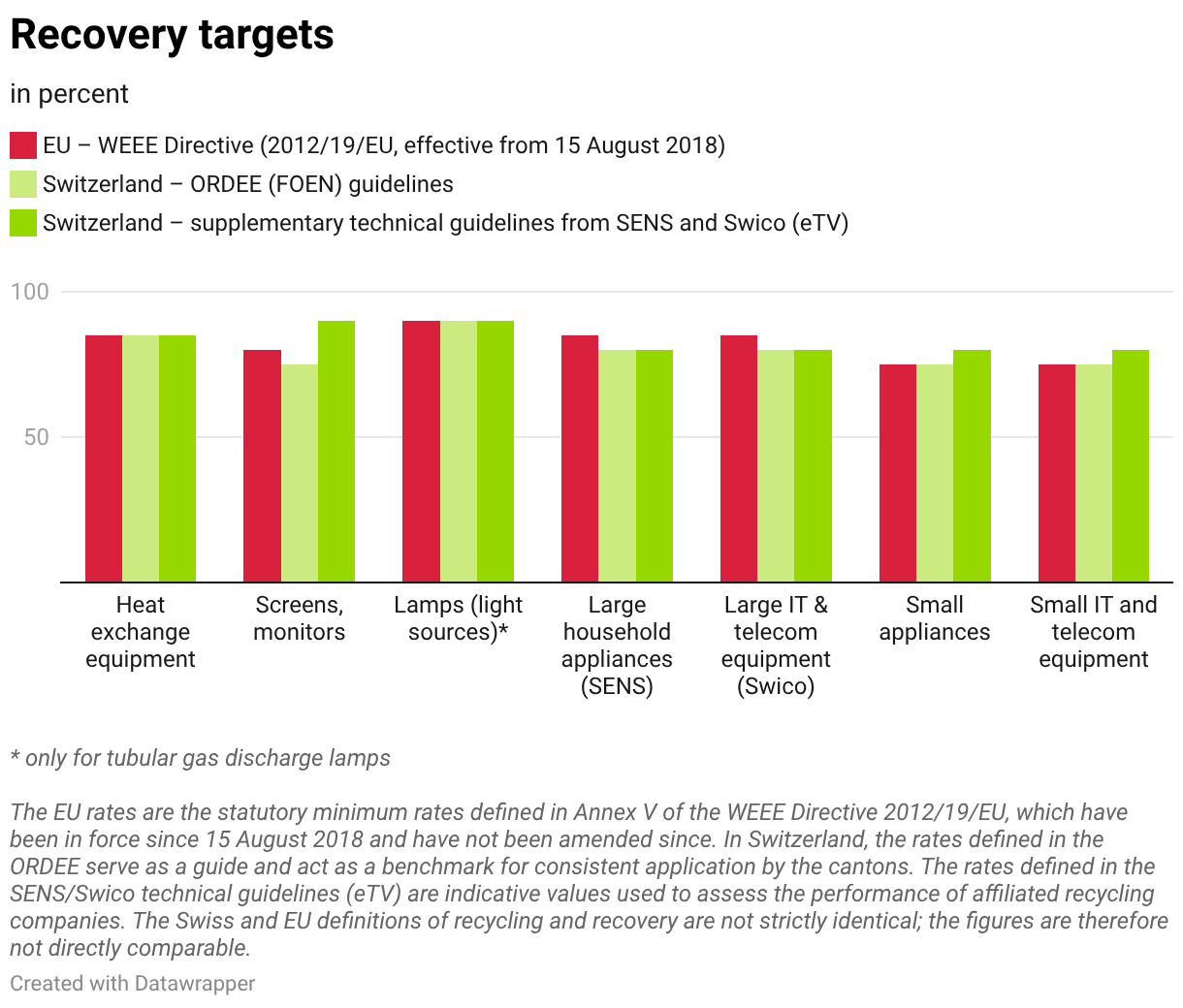
Differences in the methodology used to calculate recycling rates
Recycling and recovery rates are assessed using batch tests. There are methodological differences between Switzerland and the EU regarding the implementation of these batch tests and the interpretation of the results. In Switzerland, certain treatment technologies are not classified as recycling if they do not enable material recycling in the strict sense of the term, or if the data is incomplete. This applies in particular to certain uses of inert materials, such as glass or concrete in landfill construction, and to metals recovered from slag following incineration. Although metals can be extracted during the processing of slag, the efficiency of this recovery is limited, particularly in the case of the fine fractions from shredder residues, and varies depending on the plant and technology used.
In several European countries, comparable technologies can be considered as recycling, leading to higher reported recycling rates without necessarily making any difference in terms of actual environmental performance. Furthermore, Switzerland places particular emphasis on controlling hazardous substances, sometimes at the expense of achieving the highest possible recycling rates.
The Swiss approach aims to more accurately reflect the technical realities of the processes and avoid overestimating recycling performance. Due to these methodological differences, recycling rates in Switzerland and the EU are not directly comparable.
Differences in context and recycling practices
Finally, differences in context also contribute to the observed deviations. The metal content in devices has been decreasing over the years. Due to the high standard of living, the WEEE marketed in Switzerland is often newer and contains less metal than in some European countries.
In some categories, particularly large household appliances, plastic recycling is currently less developed in Switzerland. The requirements could be tightened in future, provided that economically and environmentally viable recycling options are available.
These two factors may help explain the lower recycling rates observed in Switzerland compared to some European countries, particularly for household appliances covered by the SENS eRecycling system.
Dialogue between Switzerland and Europe
The Swiss WEEE recycling system has an organisational structure tailored to the size of the country and the limited number of stakeholders, which facilitates coordination between the take-back-systems, technical committees, recycling companies and authorities. This configuration facilitates the gradual and relatively rapid development of technical and methodological requirements.
Unlike the European framework, whose implementation remains inconsistent across Member States and even within certain countries depending on the region and/or take-back system, the Swiss take-back-system is characterised by the consistent application of technical requirements and methods throughout the country. Swiss take-back-systems also attach particular importance to the quality of handling methods and the control of hazardous substances, going beyond mere achievement of quantified indicators; this can lead to different methodological considerations without compromising overall environmental performance.
However, this national approach is closely integrated with European stakeholders. SENS eRecycling and Swico Recycling are members of the WEEE Forum and actively participate in the sharing of best practice, particularly with regard to batch testing methodology. Representatives of the Swiss take-back-systems also participate in the European working groups responsible for the further development of the CENELEC standards.