20 years of “SwicoMix” batch tests – A data analysis
Batch analyses of the past two decades show a clear trend: The metal content in electrical and electronic appliances has been declining significantly. This has direct consequences for the recycling rate, which increasingly depends on plastics recycling. At the same time, the data reveal remarkable quality differences between the batches and call for a rethink of the objectives.
Batch tests: The objectives
In addition to the annual audits, batch tests are also conducted at the recycling companies as part of the conformity review. These are controlled testing procedures in which a defined quantity of electronic waste is processed under supervision. The preparation, processing and evaluation of such tests is associated with a great deal of effort – for the recycling companies and the take-back systems as well as the technical inspection bodies. All the more so because today, for most treatment processes, a batch test is carried out every two years per recycling company. However, this high level of effort is worthwhile. On the one hand, the accompanied batch tests enable the auditors to make a detailed assessment of individual treatment processes under real conditions. On the other hand, detailed mass balances are generated during the batch test, and the output fractions are carefully documented through to their final utilisation. This enables calculation of the recycling and recovery rates achieved and provides information on the material composition of the individual treatment types – data that cannot be collected from the annual material flow and that form an important basis for further analyses, such as life cycle assessments.
20 years of “SwicoMix”
Batch tests have been conducted at Swico Recycling since its inception in 1994. With the merging of the technical regulations of Swico Recycling and SENS eRecycling in June 2009, the requirements were standardised and established as the official state of the art. Shortly thereafter, the RepTool software developed by the European WEEE Forum for the standardised and detailed evaluation of batch tests was also introduced. The best documented treatment stream at Swico Recycling is the “SwicoMix,” which consists of small appliances from IT and consumer electronics without screens. Here, after the introduction of RepTool, test data were retrospectively recorded back to 2006. This means that data are now available covering a period of 20 years – a unique achievement.
Trends & insights
A look at the data series of the SwicoMix batch campaigns is like a journey through the history of technology. What was once heavy and predominantly metal is now lightweight and made from many different materials, often composites. The current analyses confirm that the composition of electronic waste has fundamentally changed.
A gradual reduction in the use of metal
The most striking finding from the long-term data is the continuous decline in the proportion of metal used. While the total metal content was still at peak values of over 65% in some cases in the early 2010s, it has settled at a significantly lower level in recent years.
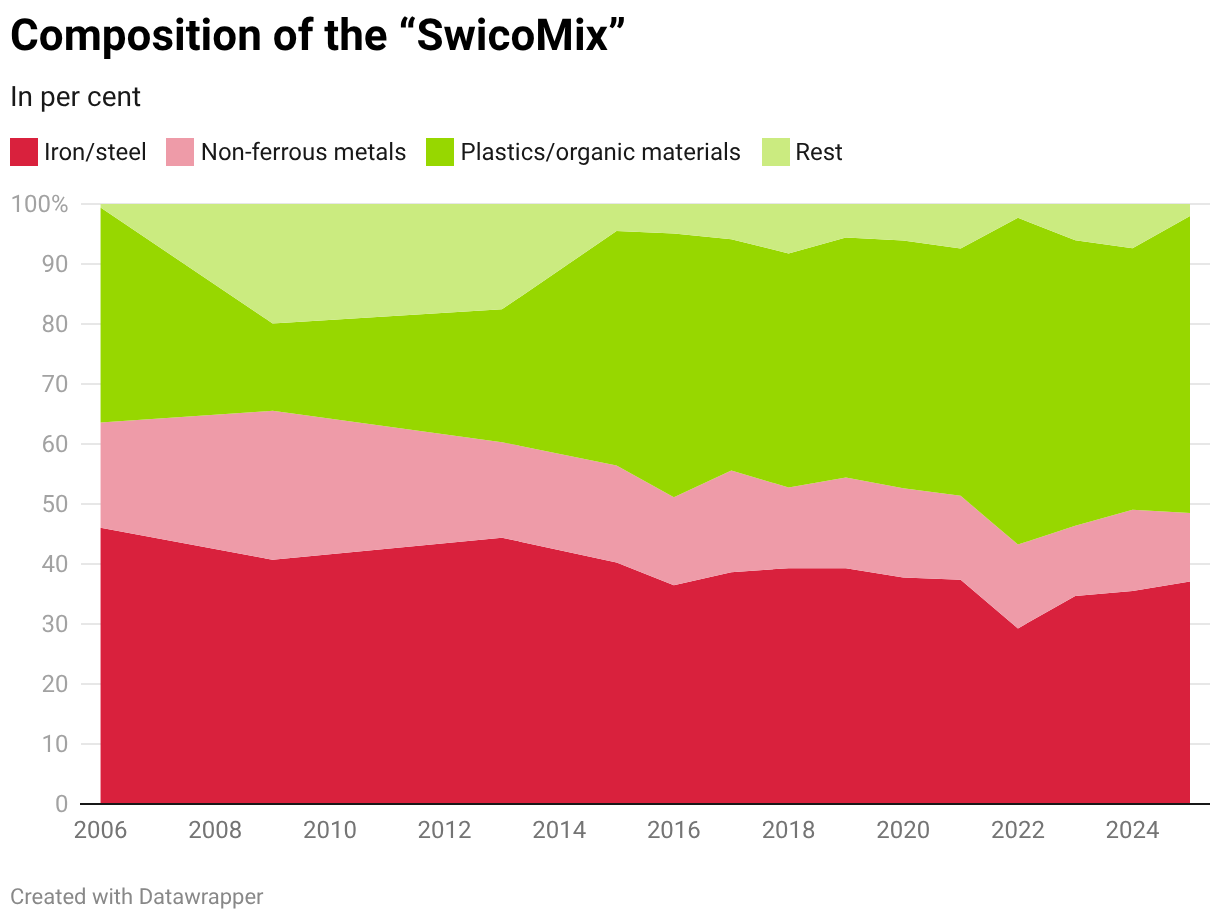
This reduction is not coincidental, but a structural trend. The miniaturisation of components and the replacement of metal housings by high-performance plastics result in a steady reduction in the presence of iron, copper and aluminium per device. Figure 1 impressively shows how the plastic content has almost doubled over the last 20 years at the expense of the metal content.
The impact on the recycling rate
This metal reduction has direct effects on the overall recycling rate. Since metals still represent the main fraction that is materially recovered from the “SwicoMix”, the recycling rate is closely linked to the metal content.
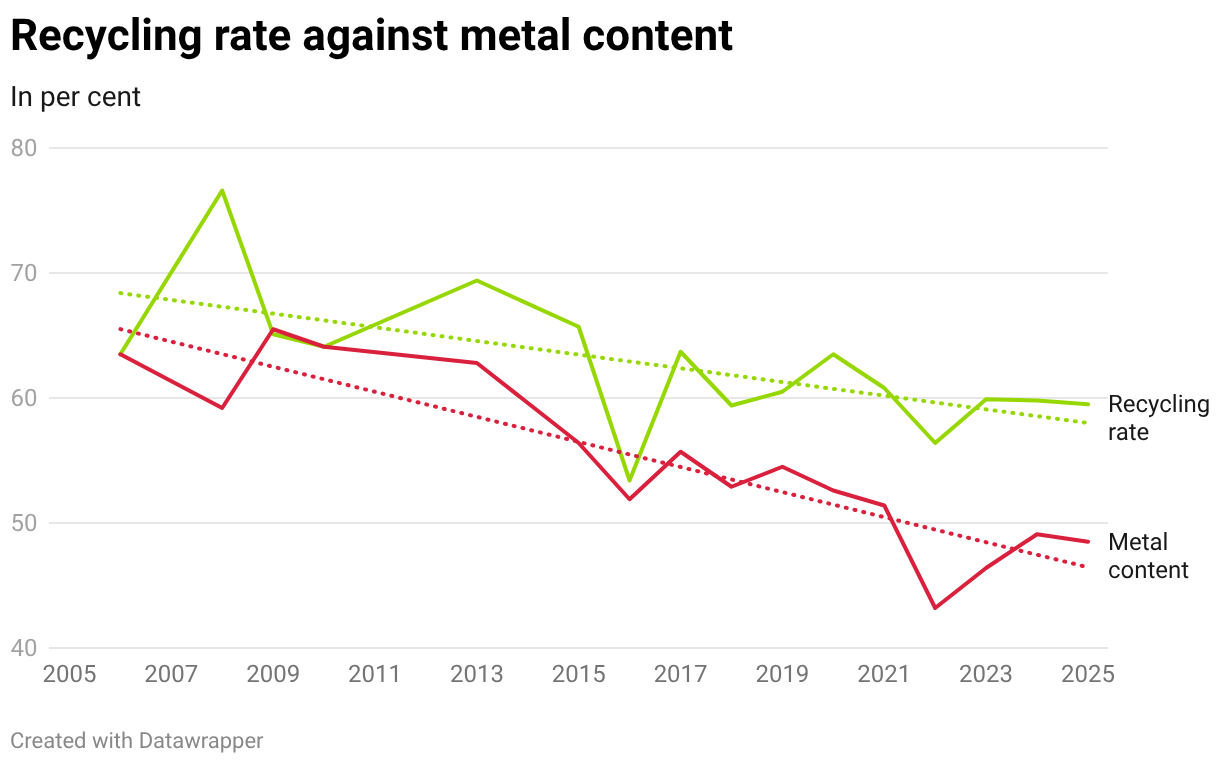
The correlation is almost linear: For example, if the metal content in the input material decreases by 10%, the achievable recycling rate also decreases by a similar amount. The physical limit of the recycling rate is therefore primarily determined by the design of the devices, even before the first shredder begins operating. As can be seen in Figure 2, the two curves increasingly drift apart: While the metal content continues to decrease, the recycling rate declines less sharply. This indicates that the elimination of metals can increasingly – at least partially – be offset, particularly through technological advances in processing the rapidly increasing plastic content.
Plastics as the deciding factor
In this context, plastics recycling is becoming more and more important. As metallic components are increasingly being replaced by plastics, the proportion of plastics is now nearly 50 per cent. It is therefore crucial that these plastics are not just incinerated but passed to recycling processes. While recycling rates of almost 100 per cent are possible for metals, the situation with recycling plastics is more complex. On the one hand, a variety of different polymers are used in electronics. These must be separated. On the other hand, there are increasingly strict requirements for the removal of plastics that are contaminated with additives containing hazardous substances. Due to these challenges, only about 50 per cent of the plastics that are sent for recycling can actually be recycled. As a result, the recycling of plastics today contributes about 10 to 20 percentage points to the total recycling rate. Without the advanced technologies for plastic sorting and recycling, the decline in the overall rate would be even more drastic in parallel with the reduction in metals.
Quality fluctuations: The original source is decisive
The analyses also show that “SwicoMix” consists of a number of sources. When comparing different batches, significant differences in material quality are noticeable – especially in the metal content.
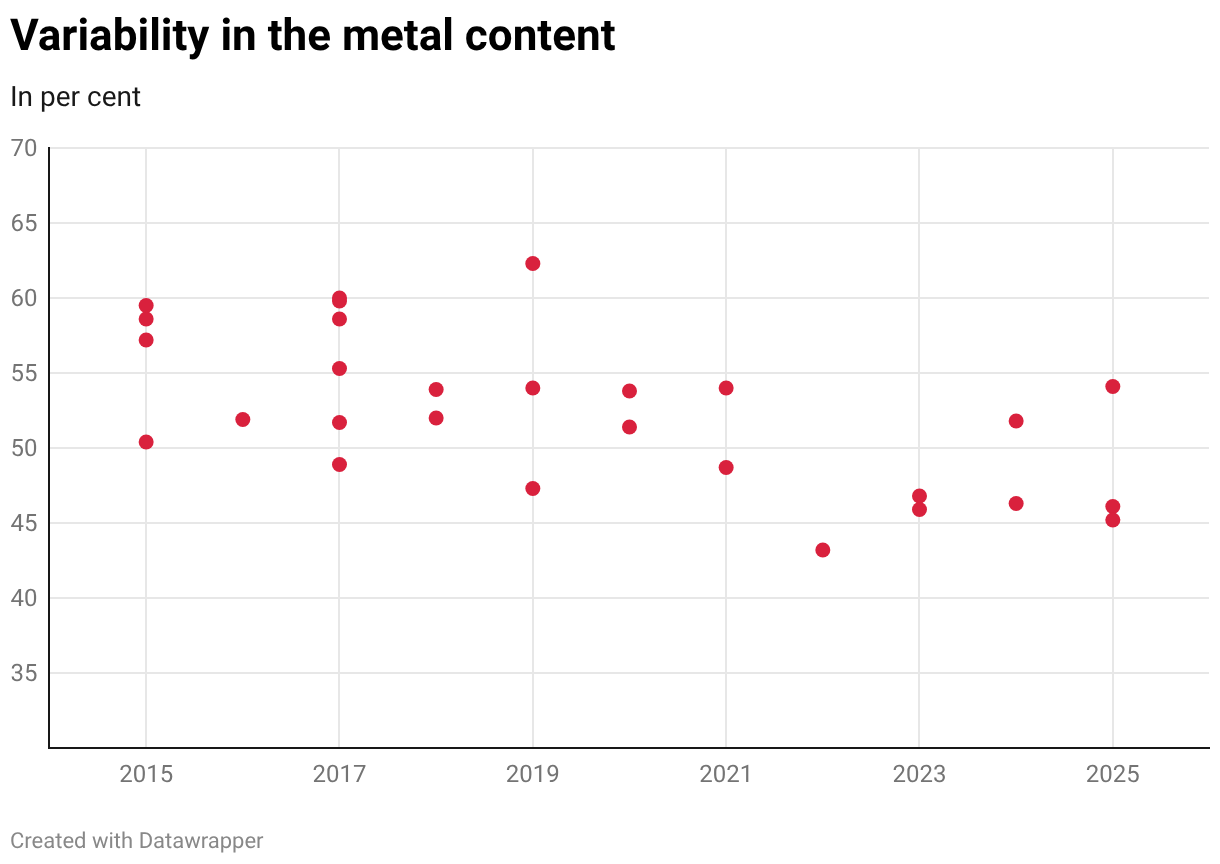
Some recycling companies seem to consistently receive “more precious” material than others. While the exact causes are not explicitly known, practical experience suggests that the collection channels could be a contributing factor.
It is assumed that material from the business environment (B2B, indirect channels) tends to have a higher recyclable material content than the traditional collection material from private households (B2C). The latter is often more heterogeneous and increasingly contains small appliances with a high proportion of plastic. This hypothesis would explain the variance observed, even if it cannot be conclusively demonstrated from the available batch data alone.
What next?
Against the backdrop of these dynamic material changes, regulatory assessment has also changed. The current recycling target of 60% (according to supplementary Technical Guidelines, eTV ) is the result of an adjustment to reality – from formerly 65% (until 2019) to 55% (2020 to 2024)1. More important than the absolute figure, however, is the paradigm shift in Swiss enforcement practice: the ratio is increasingly understood as an indicative value and no longer as a rigid limit. This takes into account the fact that recycling companies cannot influence the declining metal content in the input. Complementary to the recycling rate, the monitoring of the material losses also comes into focus. According to eTV, key materials such as iron, aluminium, and copper in the residual fractions (e.g., incinerated fractions) are quantified by means of sampling and analyses. The aim is to ensure that technically recoverable recyclable materials do not end up in waste.
Batch tests and life cycle assessment: an indispensable bridge
The batch tests provide far more than just rates for comparison with the indicative values. They form the fundamental data basis for life cycle assessment. Only if we know exactly how much copper, gold, plastic and other recyclable materials have actually been recovered (and how much energy was required for this) can the environmental benefits of recycling be scientifically calculated. The detailed recording of fractions through the batch tests makes it possible to determine precisely the environmental credits for the replaced primary raw materials and thus make the system’s environmental footprint transparent.
Outlook
The data of the last 20 years teach us that stability in the composition of electronic waste is an illusion. We must prepare ourselves for a future in which the absolute mass of metals continues to decrease, while the complexity of composite materials increases. For the coming years, it will be crucial to refine the technologies for plastics recognition further and establish loss monitoring as a central control tool. The pursuit of a blanket record recycling rate will, as a result, give way to smarter, quality-oriented securing of resources.
Notes and Sources
- The specification was matched in 2020 to the European CENELEC standard, which is also applied in Switzerland. In 2025, the guide value was raised again in agreement with the recycling companies to reflect the high standard in Swiss WEEE recycling.