Recycling of photovoltaic modules in Switzerland: trends in material flows and a new partner using a pyrolysis process
The number of photovoltaic modules collected and processed in Switzerland is rising rapidly. Collection and processing have been organised operationally since 2013 through a partnership between SENS eRecycling and Swissolar. Since 2025, the system has been expanded to include a new partner recycling facility, whose innovative process incorporates a pyrolysis step that enables the recovery of high-quality materials.
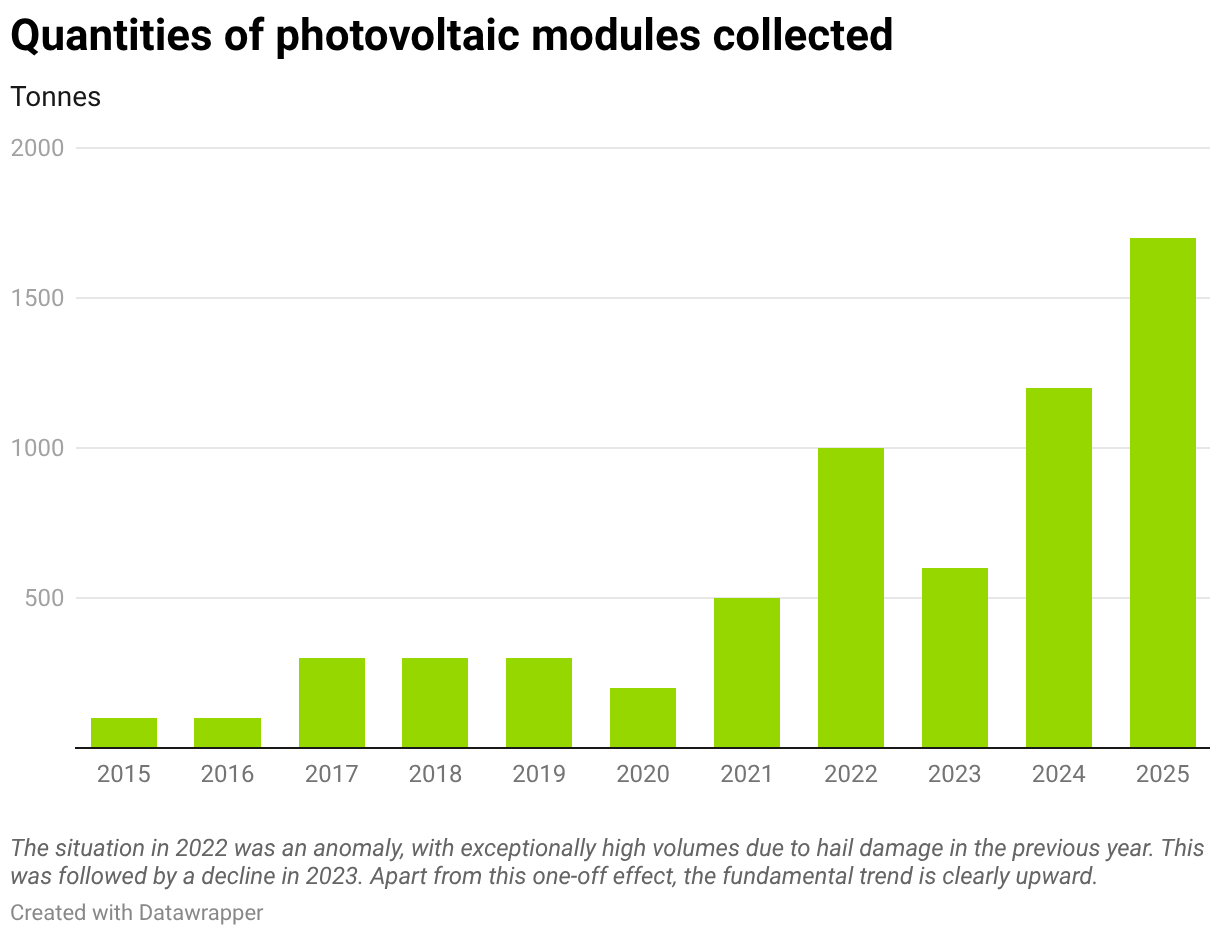
Volumes have been fast growing since 2015
Since statistical monitoring began, the number of photovoltaic modules collected and processed in Switzerland has increased significantly, from around 100 tonnes in 2015 to 500 tonnes in 2021, and then to 1700 tonnes in 2025. We saw a one-off anomaly in 2022, with an exceptionally high volume linked to hail damage that occurred in 2021, followed by a downward correction in 2023. Beyond this one-time effect, the underlying trend is clearly on an upward trajectory.
Structural growth outlook
Over the longer term, a very sharp increase in flows of end-of-life photovoltaic modules is expected, even without any further expansion of the installed capacity, due to the ageing of existing installations. In Switzerland, cumulative installed photovoltaic capacity increased from around 10 to 20 MW at the turn of the 2000s1 to over 8,000 MW by the end of 20242. Changes in installed capacity therefore serve as an indicator of the volume of modules commissioned and, with a time lag of around 25 years corresponding to the typical lifespan of such installations, of the tonnage of modules reaching end-of-life and entering the recycling stream today and in the coming years. This growth in installed capacity – increasing several hundred-fold in just over two decades – means that, in the coming years, the volume of modules sent for recycling will dwarf what we see today. If the current trend towards expanding solar power continues, these flows will rise even further.
Collection and recycling scheme organised through SENS eRecycling and Swissolar
In Switzerland, the take-back of photovoltaic panels has only been a legal obligation since the 2021 revision of the Ordinance on the Return, Taking Back and Disposal of Electrical and Electronic Equipment (OREE). In fact, it was only during this revision that the scope of the OREE was extended to include photovoltaic panels. However, SENS eRecycling, in partnership with Swissolar, has had a voluntary industry scheme for the collection and recycling of photovoltaic panels nationwide since 2013, with a view to ensuring the proactive and harmonised management of these material flows.
For SENS eRecycling partners, the scheme is funded by an advance recycling contribution (ARC). This is included in the retail price of the modules, in line with the principle applied to other categories of equipment managed by SENS eRecycling. The contribution amounts to 4 centimes per kilogram of panel, or approximately CHF 0.80 for a 20-kilogram panel. Authorised recyclers are subject to specific technical requirements, in particular those set out in the CENELEC EN 50625-2-4 standard on the processing of photovoltaic modules.
The collection process
When a photovoltaic installation reaches end-of-life, it is dismantled by a specialised installer. The modules are then collected on-site and transported to a recycler recognised by the SENS eRecycling system, or, for small quantities, delivered to a collection centre. The entire stream is integrated into SENS eRecycling’s existing organisational structure, with the same traceability and monitoring requirements as for other categories of waste electrical and electronic equipment, notably through regular audits, the reporting of material flows in WEEE Flow, and the recording of batch tests in RepTool. This approach ensures nationwide coverage and a consistent standard of control right through to the final stage of processing.
Composition of photovoltaic panels and recycling targets
Photovoltaic modules are mainly composed of glass, an aluminium frame, polymer materials used for encapsulating and protecting the cells, silicon cells that convert solar energy into electricity, copper for electrical conductivity, and other metals in smaller quantities, notably silver, which is used for metallising the photovoltaic cells. The processing targets for photovoltaic modules aim for a recycling rate of at least 80% and a recovery rate of at least 85%.
Recycling streams in the Swiss system
To date, the Swiss photovoltaic module recycling system relies on two specialist recyclers: KWB Planreal AG, a long-standing partner, and ROSI Alpes SA, which joined the scheme in 2025. The addition of a second partner has increased processing capacity and helped to keep pace with rising volumes.
Both companies offer collection and sorting services in Switzerland, while the final processing takes place at facilities in Germany and France. The process used by ROSI Alpes SA includes a pyrolysis step.
A closer look at the treatment process involving a pyrolysis step
There are several steps involved in processing at ROSI Alpes SA in Saint-Honoré, near Grenoble, France. First, the modules undergo semi-mechanical pre-treatment, which involves removing the aluminium frame and taking out the cables and junction boxes. These components are then channelled into the standard recycling streams for waste electrical and electronic equipment (WEEE).
The second step is what makes the ROSI process unique: continuous furnace pyrolysis, designed to remove the organic fraction from the modules, primarily the encapsulation plastics. These materials can no longer be recycled as raw materials but are recovered for energy. The energy produced is used to power the process and to heat the industrial site. This pyrolysis step ensures effective separation of the various components of the panels.
In a third step, mechanical separation processes, similar to those used for other WEEE, are used to isolate the glass, copper wires and photovoltaic cells. Finally, the photovoltaic cells are chemically treated before undergoing mechanical processes, which allows the residual aluminium to be separated and then the silicon and silver to be isolated. The recovered silicon is of a high purity, opening up opportunities for use in the solar or semiconductor industries, while the silver is recycled within specialised industrial sectors.
Notes and Sources
- Installed capacity of photovoltaic modules in Switzerland: 8 MW in 1995, 16 MW in 2000, 28 MW in 2005. Source: Swissolar. (2017). Solar energy statistics – Survey of solar installations in Switzerland (in French). Historical data on installed photovoltaic capacity compiled in collaboration with the Federal Office of Energy.
- Swisssolar, article dated 10 July 2025: Growth confirmed: Solar power for 2 million households (in French).