Life cycle assessment of SENS eRecycling and Swico Recycling 2025
The additional environmental benefits of the recycling systems operated by SENS eRecycling and Swico Recycling amounted to around 1,400 billion environmental impact points (EIP) or 236,600 tonnes of CO2-eq in 2025. The 1.4 billion EIP saved is roughly equivalent to the environmental impact of the annual consumption of the residents of Biel1. The 236,600 tonnes of CO2 equivalent saved is roughly equivalent to the annual transport emissions of the city of Lausanne. What is particularly noteworthy is that it is not only the recovery of recyclable materials from waste electrical and electronic equipment (WEEE) that is of great importance, but above all the proper removal of hazardous substances.
Environmental and climate benefits at a glance
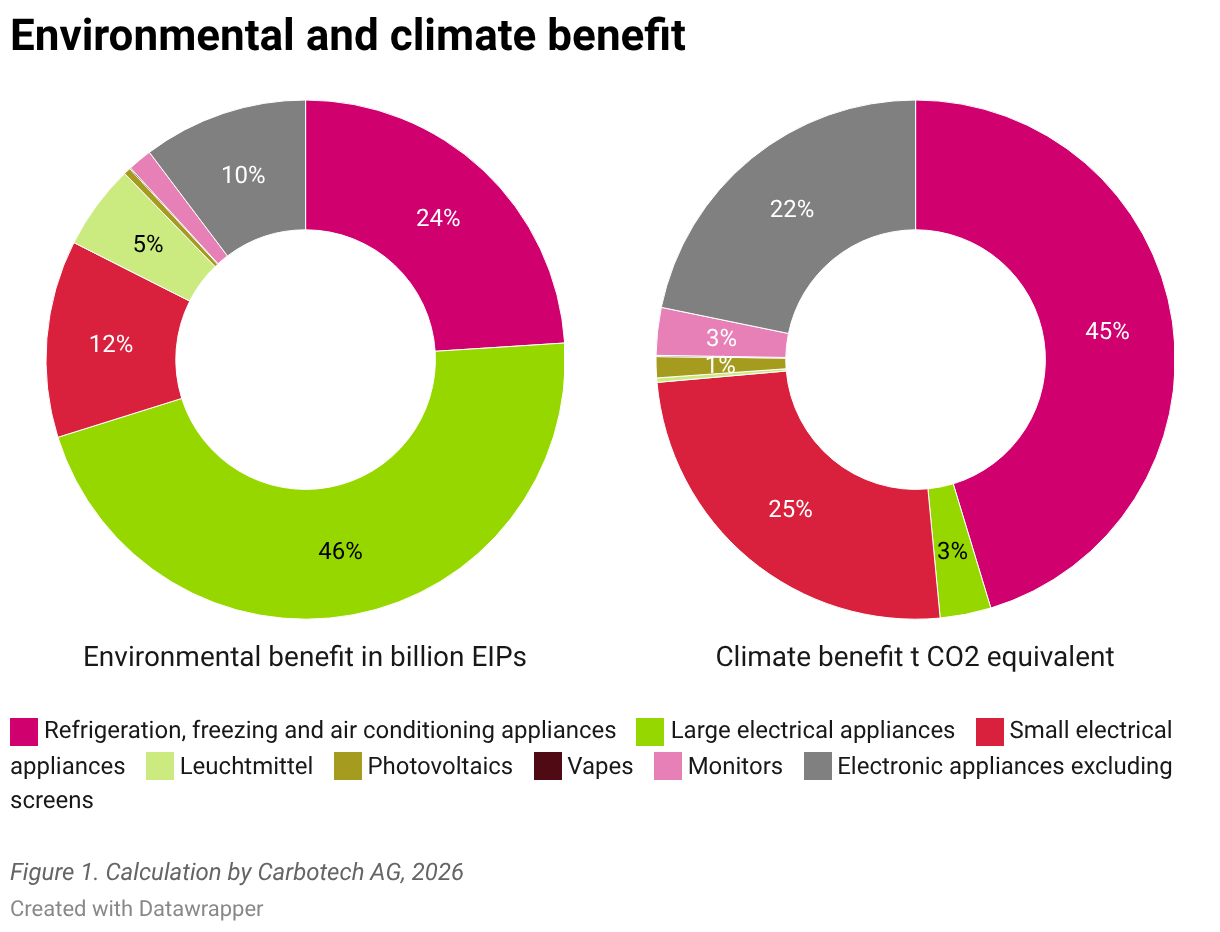
Figure 1 shows the pro-rata environmental and climate benefits of all appliance categories for the year 2025. Around 46 per cent of the environmental benefit is attributable to the recycling of large electrical appliances, 24 per cent to refrigerators, freezers and air conditioners, around 12 per cent to small electrical appliances, 10 per cent to electronic devices excluding screens, 5 per cent to lighting equipment, 2 per cent to monitors, 0.4 per cent to photovoltaics and 0.1 per cent to vapes.
Refrigerators, freezers and air conditioning units account for the largest share of the total climate benefits, at 46 per cent. This is followed by small electrical appliances (25 per cent), electronic equipment excluding screens (22 per cent), large electrical appliances and monitors (3 per cent each), photovoltaic equipment (1 per cent), lighting equipment (0.3 per cent) and vapes (0.1 per cent).
Contribution of the appliance categories
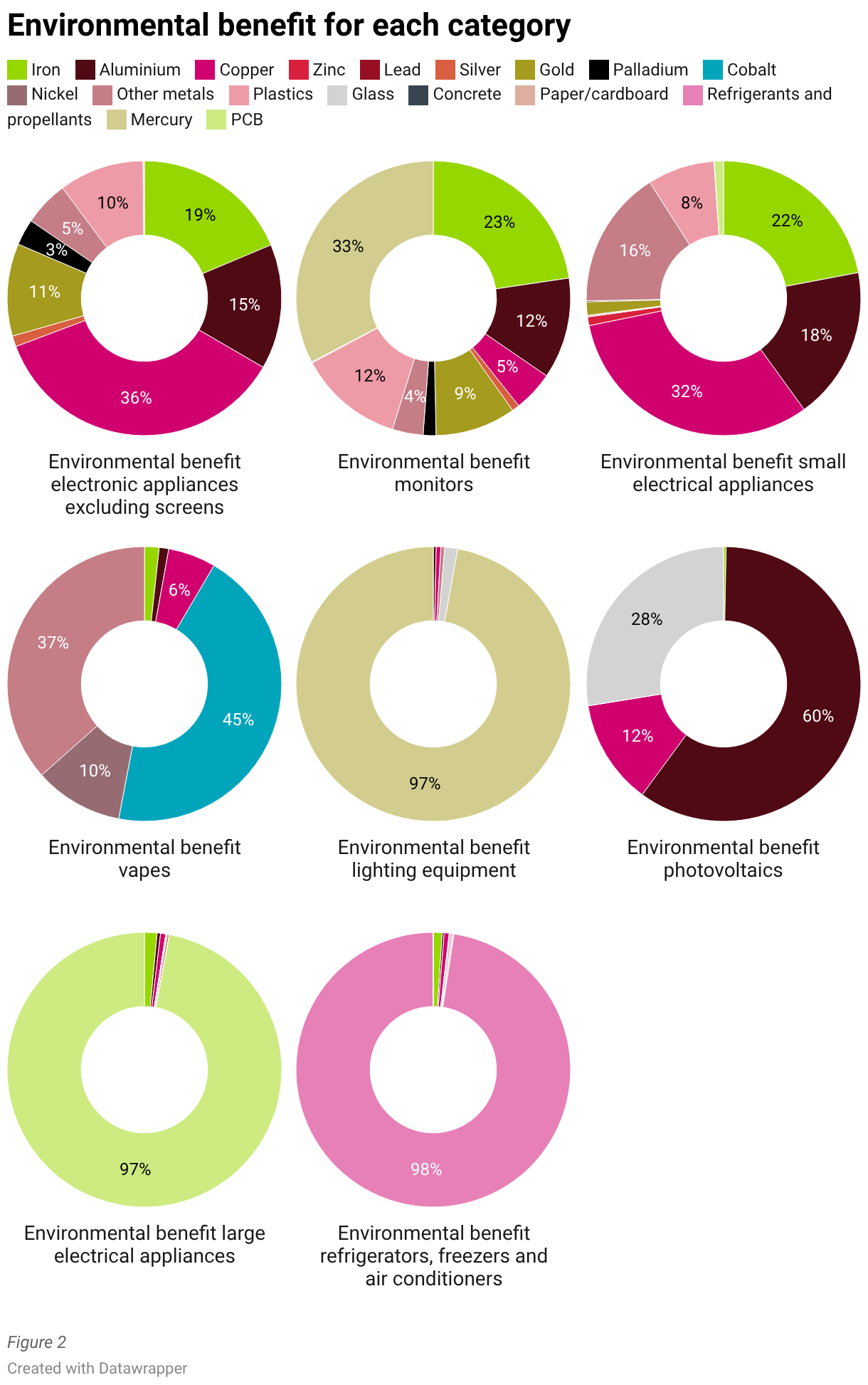
The contribution of the individual appliance categories to the environmental and climate benefit depends on which recyclable materials are recovered from the appliances and which hazardous substances are removed and properly disposed of. The following graphs in Error: Reference source not found show the environmental benefits per appliance category, broken down into the recovery of recyclable materials and the removal of hazardous substances. It is noticeable that the recovered recyclable materials vary greatly by appliance category and that both the removal of hazardous substances and the recycling make significant contributions.
When refrigerators, freezers and air conditioning units are recycled, over 95 per cent of the environmental benefit comes from the removal of refrigerants and blowing agents, which deplete the ozone layer and have a significant impact on the climate due to their high global-warming potential (GWP). (See article “Refrigerators”) Recovering recyclable materials plays only a minor role in this appliance category by comparison.
In large electrical appliances, most of the environmental benefit, 97 per cent, is due to the proper disposal of polychlorinated biphenyls (PCBs) from capacitors. PCBs cause significant environmental damage even in the smallest quantities. Here too, the contribution of recovery of recyclable materials is of little relevance compared to the removal of hazardous substances.
In the case of lighting equipment, 97 per cent of the environmental benefit is attributable to the removal of mercury; by comparison, the recovery of metals and glass contributes only to a small extent. As for photovoltaic modules, the environmental benefit is mainly in the recovery of aluminium, glass and copper. In recycling vapes, the recovered metals, especially cobalt and nickel, make a significant contribution to the environmental benefit.
The environmental benefit of the removal of hazardous substances is significantly lower for small electrical appliances and electronic devices, excluding screens, than for large electrical appliances. This is because large electrical appliances have a longer service life and older models are more likely to feature capacitors containing PCBs, whereas small electrical appliances and electronic devices (excluding screens) now rarely contain such components. An exception to this are ballasts from light fixtures, which may also include capacitors containing PCBs2. Plastics containing brominated flame retardants are extracted from the recycling system and sent for incineration; this does not result in any additional environmental benefits compared with the reference scenario of incineration at a waste-to-energy plant. Consequently, the environmental benefits of small electrical appliances and electronic equipment (excluding displays) are primarily based on the recovery of recyclable materials, in particular base metals such as copper, iron and aluminium, but also plastics and precious metals such as gold, silver and palladium, which make a significant contribution due to their high environmental value per unit of mass. Recovery from the so-called “urban mine” – particularly from high-grade printed circuit boards found in electronic appliances – is significantly more environmentally friendly than mining from natural deposits, where the gold content per tonne is many times lower. The recycling of plastics is also becoming increasingly important, as the metal content of modern appliances tends to decrease while the proportion of plastic increases (see the article on Swico’s batch trial).
More than a third of the environmental benefits of recycling display equipment come from the removal of mercury-based backlights. Another key factor here is the recovery of recyclable materials such as iron, aluminium and copper, as well as plastics and the precious metals gold, silver and palladium.
How is the environmental and climate benefit calculated?
The environmental and climate benefits are calculated as the difference between the current situation, with the existing take-back schemes SENS eRecycling and Swico Recycling, and a reference scenario without these schemes. The current situation takes into account every stage of the process, from collection and sorting through to manual and mechanical processing, and on to the proper disposal of hazardous materials and the recycling of recoverable materials. The emphasis is on two aspects: on the one hand, the environmental impact is reduced through the proper removal and treatment of pollutants; on the other hand, resources are conserved through material recycling, with secondary raw materials replacing primary materials.
The benefits of the removal of hazardous substances are calculated as the difference between the cost of proper disposal and the emissions prevented from entering the environment. In recycling, the benefit arises from the difference between the cost of processing secondary materials and the reduction in environmental impact achieved by avoiding the production of primary materials.
Reference scenario
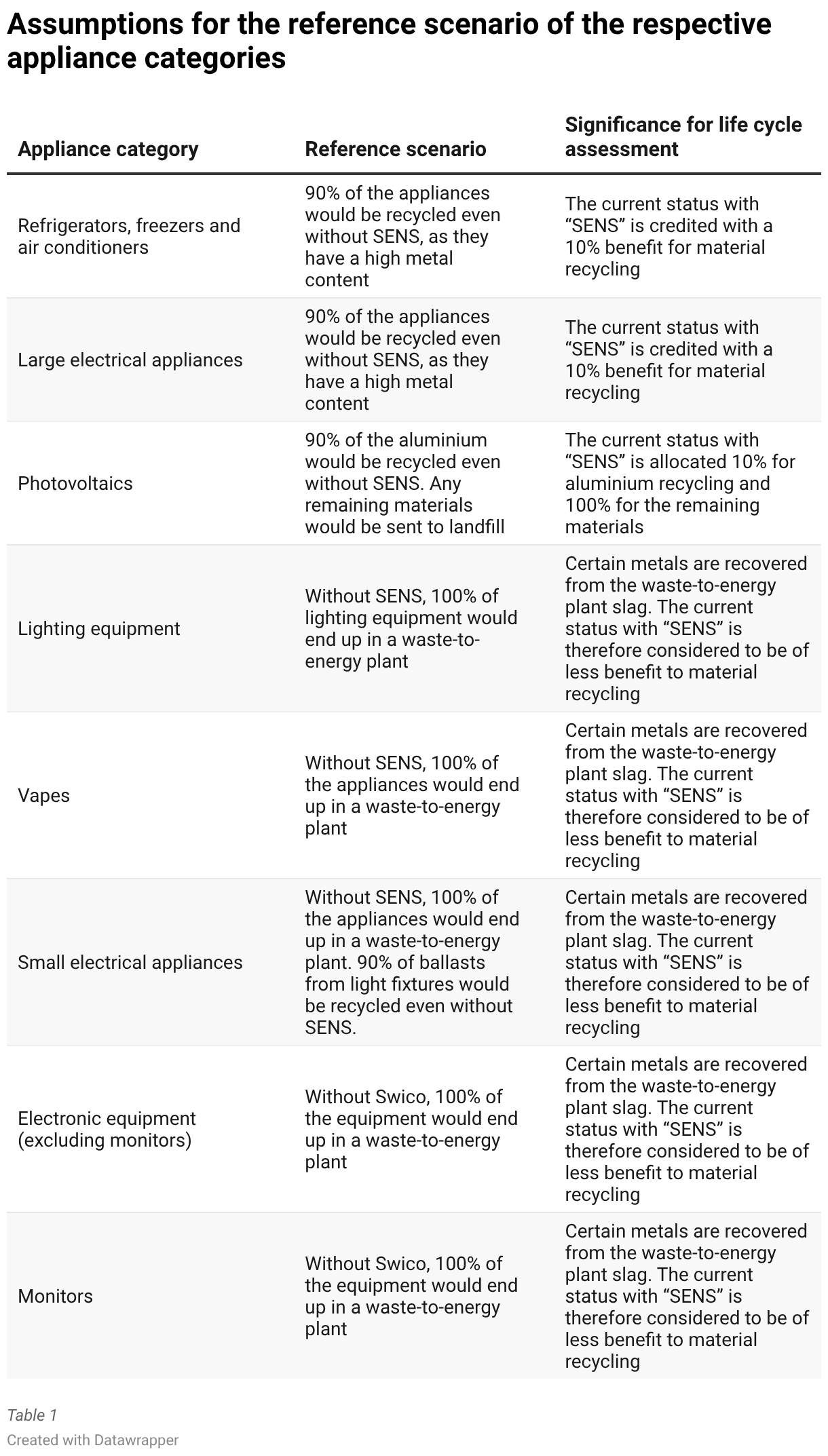
For the life cycle assessment, it is assumed that in the reference scenario “without SENS” or “without Swico”, the number of appliances is the same as in the current system. The key difference lies in the treatment of the appliances: in the reference scenarios “without SENS” and “without Swico”, some of the economically valuable recyclable materials would indeed be recovered, but the complex and costly process of the removal of hazardous substances would largely be overlooked.
For the reference scenario “without SENS” or “without Swico”, a range of different outcomes is conceivable – from full-scale landfilling or incineration to disposal in accordance with the law without organised take-back schemes. As there is no empirical data available for these hypothetical scenarios, detailed modelling of the possible disposal routes would require numerous assumptions regarding volume distributions and treatment paths. In order to minimise the number and scope of the assumptions, a plausible, simplified middle ground was therefore selected for each category of equipment in this study, to serve as a basis for comparison when quantifying the environmental benefits of existing systems. The specific assumptions for each appliance category are summarised in Table 1.
Data basis
Data on the quantities processed by appliance category and recycling partner is available from the annual material flow survey (see article “Volumes”). Based on the batch tests carried out every two years by every Swico or SENS recycling partner for each category of appliance processed, the absolute volumes of recovered recyclable materials and extracted hazardous substances can be accurately extrapolated. For materials that are significant in terms of mass fraction (base metals, plastics, etc.), data from weighing and dedicated analyses is available from subsequent processors. However, this is not usually the case for substances present in very small proportions by mass (Hg, PCBs, precious metals). This involves the use of chemical analyses of the relevant fractions, statistical evaluations of end-users, and data from the literature.
Conclusion
The life cycle assessment shows that, by working together with consumers, manufacturers/importers, retailers, service partners (collection points, transport companies, recycling facilities) and public authorities, SENS eRecycling and Swico Recycling generated significant environmental benefits in 2025. The proper disposal of WEEE items has reduced Switzerland’s annual environmental impact by around 1 per cent3, which is a very significant figure for a single measure. The most significant contribution to this environmental benefit comes from the prevention of PCB emissions through the proper disposal of capacitors that contain PCBs. Despite the fact that fewer and fewer capacitors containing PCBs are found in waste electrical equipment today, this pollutant still has the highest environmental impact potential, according to the underlying calculations. For this reason, capacitors must continue to be removed with the utmost care and disposed of properly.
It is also important from an environmental perspective to prevent the release of other pollutants, such as refrigerants, blowing agents and mercury, through controlled, appropriate disposal. These hazardous substances are becoming an increasingly significant factor in life cycle assessments because the fluorine- and chlorine-containing ones among them were banned later than PCBs, meaning that their levels in appliances will decline at a much slower rate. When it comes to climate benefits, too, the prevention of emissions from halogenated refrigerants and blowing agents plays a key role due to their high global warming potential.
The recycling of recyclable materials such as iron, copper, aluminium and plastics, as well as precious metals such as gold, silver and palladium, currently contributes less to the overall environmental benefit in relative terms, due to the prominence of hazardous substances across both systems. However, this proportion is steadily increasing, particularly as there are fewer and fewer PCBs in the appliances. This trend is already clearly evident today in small electrical appliances and electronic equipment. In absolute terms, recycling recyclable materials makes a great deal of ecological sense, as the environmental benefits (conservation of resources) far outweigh the costs of processing (energy consumption, transport, etc.). When climate benefits are considered in isolation, material recovery becomes even more significant for the system as a whole.
How can environmental benefits be quantified?
Another advantage is that the method also takes into account environmental aspects that are particularly relevant to this life cycle assessment, including emissions of persistent organic pollutants (POPs) and resource consumption. Although it reflects Swiss environmental policy, it is also recognised internationally. The results are expressed in environmental impact points (EIP).
The climate benefit was calculated using the IPCC 2021 GWP 100a method. Unlike the ecological scarcity approach, this method takes into account only greenhouse gas emissions and their impact on the climate. The method is internationally recognised; the results are expressed in kg CO2 equivalent.
Notes and Sources
- Environmental footprints in Switzerland: trends between 2000 and 2023 (EBP/Impact Economics 2026)
- The calculation of the environmental benefits resulting from the removal of capacitors is based on data from the 2019 capacitor study, which is due to be updated this year.
- Environmental footprints in Switzerland: trends between 2000 and 2023 (EBP/Impact Economics 2026)