PFAS from the recycling of waste electrical and electronic equipment
In 2025, SENS eRecycling and Swico Recycling conducted the first systematic investigation of per- and polyfluoroalkyl substances (PFAS) in fractions from waste electrical and electronic equipment (WEEE) recycling in order to assess their presence, concentrations and potential risks. The results show that PFAS can be detected in many fractions on the order of a few micrograms per kilogram. The individual substance PFBS is the most common, while other PFAS are found only sporadically. The data provide an important basis for future decisions in the circular economy.
About PFAS
Per- and polyfluoroalkyl substances (PFAS) are a large group of synthetic chemicals that have been in use since the 1940s. Due to their strong carbon‑fluorine bonds, they are exceptionally stable both chemically and thermally. This structure gives them water-, grease- and dirt-repellent properties, which is why PFAS are used in numerous everyday and industrial applications, from weatherproof clothing and non-stick coatings to food packaging and fire-fighting foams. Industrially, they are used in semiconductor production, as refrigerants, or as sealing and insulation materials1, for example.
Because they are used so widely, PFAS are released into the environment throughout their entire life cycle – during manufacture, processing, use and disposal2. Due to their extreme stability, they persist in the environment for centuries and are therefore also known as “forever chemicals”. Today, PFAS can be detected practically everywhere, both in ecosystems and in the human body. Many of these substances, or their breakdown products, are considered harmful to the environment and to human health.
PFAS in products and waste streams
PFAS are used in many products. New regulations are currently being implemented for particularly sensitive product groups. The EU has decided that food-contact packaging must be PFAS-free from August 2026. From then on, the total concentration of all measured PFAS will be limited to a maximum of 250 µg/kg (micrograms per kilogram).
Where PFAS are present in waste streams, they should be removed rather than kept in the cycle through material recycling where possible. Since PFAS cannot be completely avoided, a balance must be struck between the benefits of recycling and the harm that PFAS carried over into secondary raw materials can cause. Limits must therefore be defined to determine how much PFAS can be tolerated in secondary raw materials. This poses major challenges for the circular economy and requires reliable data on PFAS levels, tailored disposal solutions and long-term limit values for secondary raw materials3.
Initial measurement surveys of other waste streams, such as waste paper and waste textiles, show average total PFAS levels of 270 µg/kg for waste paper and 390 µg/kg for waste textiles. Among the paper samples, the highest total PFAS concentration was measured in a paper soup bowl (3,437 µg/kg), while among waste textiles, the highest concentrations were found in awnings used for sun protection on buildings (4,407 µg/kg) and outdoor jackets (4,687 µg/kg)2. Given the presence of these contaminants in various waste streams, the question arises as to whether, and to what extent, PFAS are also found in fractions resulting from the processing of waste electrical and electronic equipment (WEEE).
The SENS eRecycling and Swico Recycling inspection bodies are addressing the issue of PFAS
As part of their technical inspections, the SENS and Swico recycling companies regularly carry out batch tests. Samples taken during the batch tests have been used to analyse plastic and fine fractions for PFAS as well. The aim of this measurement survey was for the inspection bodies at SENS eRecycling and Swico Recycling to determine the types of PFAS present and the concentrations of PFAS in the fractions. The data will help to assess whether PFAS in the fractions derived from WEEE could have adverse environmental or health effects. In addition, the aim was to determine whether there is a link between PFAS and the fluorine content of the fractions. A total of 28 fractions from the processing of WEEE and two fractions from the processing of electrical cables were analysed for PFAS in the laboratory.
Amount of PFAS in fractions from the recycling of WEEE
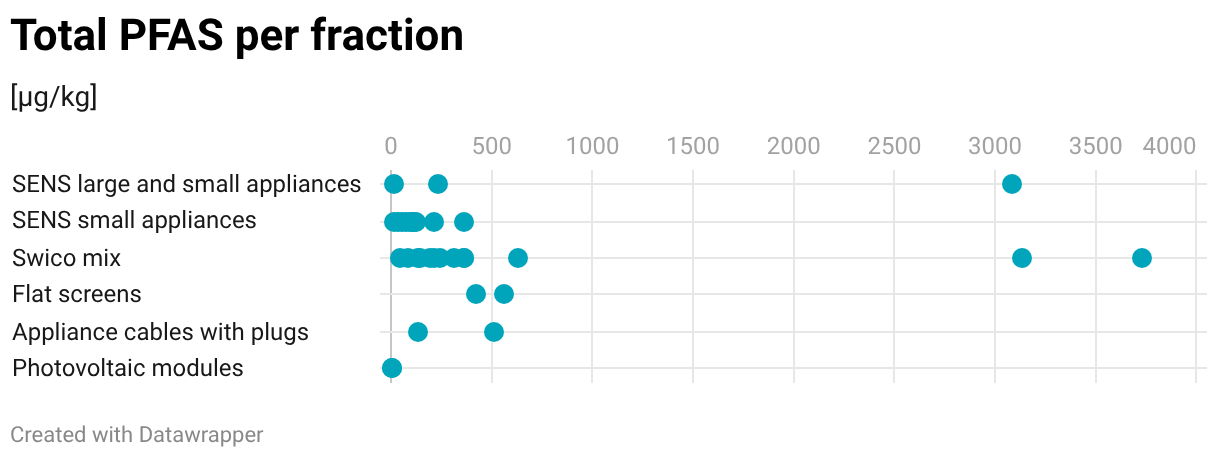
The analyses revealed PFAS concentrations ranging from just above zero to a maximum of a few thousand micrograms per kilogram (µg/kg) of sample material. These are low concentrations. A simple calculation can illustrate the scale involved: a value of 1 µg/kg corresponds to 1 gram of PFAS in 1,000 tonnes of material. Figure 1 shows that the vast majority of fractions contained between 0 and just over 500 µg/kg of PFAS. Three samples contained between 3,000 and 4,000 µg/kg of PFAS. Compared with other persistent organic pollutants, these values are significantly lower than, for example, the limit of 50,000 µg/kg for polychlorinated biphenyls (PCBs), which applies to PCB-free fractions. PCBs and PFAS are both highly persistent substances in the environment. Due to their toxicity, PCBs were completely banned in 1986. To date, there are no binding limit values for PFAS across all areas of application. A recent fact sheet from the FOEN proposes a very low guideline value of 5 µg/kg for PFAS in waste.
Given such low concentrations and the highly heterogeneous nature of the analysed fractions, questions inevitably arise regarding the statistical reliability of the results. It is therefore possible that individual readings might differ significantly in repeat analyses.
The PFAS that were found
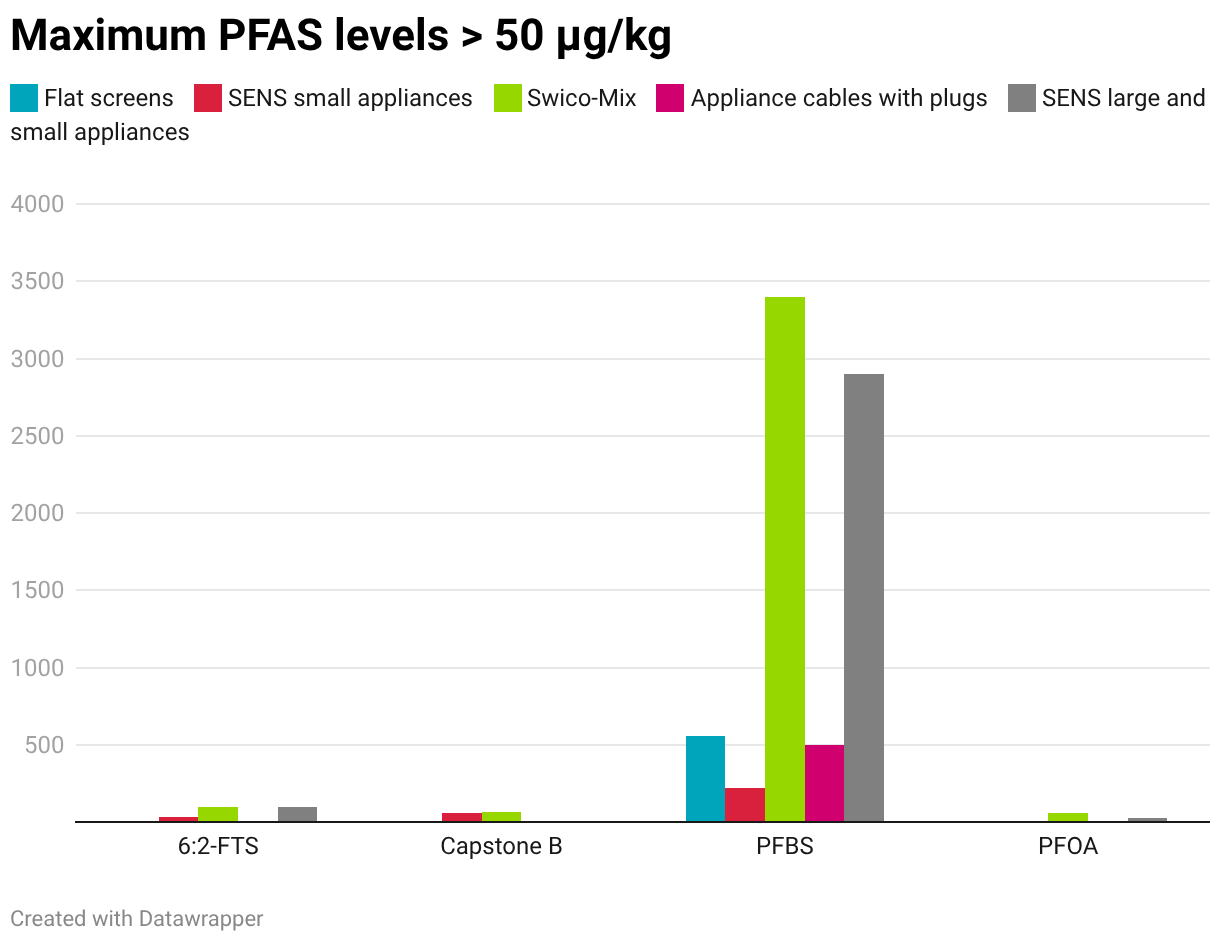
The analysis data can be used to identify which PFAS are particularly common in fractions from WEEE recycling. It is also possible that some PFAS were introduced via contaminants in either the WEEE or the processing facilities. In the three samples, which contained a total of more than 3,000 µg/kg of PFAS, the substance PFBS was responsible for the high level. Even at lower concentrations, PFBS usually accounted for the largest proportion in the samples. Other PFAS detected in individual fractions at concentrations exceeding 50 µg/kg were 6:2-FTS, Capstone B and PFOA (Figure 2). These three terms are abbreviations; their full names are as follows:
- 6:2-FTS stands for “6:2-fluorotelomer sulfonic acid”
- Capstone B is a brand name; the molecule is called “6:2- fluorotelomer sulfonamidoalkyl betaine”
- PFBS stands for “perfluorobutanesulfonic acid”
- The full name of PFOA is “perfluorooctanoic acid”
Uses of the identified PFAS
The PFAS compounds found are non-polar on one side of the molecule and are therefore fat-soluble. On the other side, they are polar and therefore water-soluble. In chemistry, these substances are known as surfactants.
6:2-FTS is used as a substitute for the more toxic perfluorooctane sulfonic acid (PFOS), which is used in the manufacture of electronic devices and components, printed circuit boards and semiconductors, as well as metal and plastic products4.
Capstone B is the same substance as 6:2-FTS, but with the addition of a second component, which is chemically classified as betaine. (Figure 4). Capstone B is widely used in fire-extinguishing foams and as a flame retardant4.
PFBS (Figure 3) is also considered a substitute for PFOS. It is used for water-, oil- and dirt-repellent coatings. Applications relevant to electrical and electronic equipment can be found in the manufacture of electronic products, in the semiconductor industry and as flame retardants in plastics4.
PFOA is primarily used as an additive in the manufacture of polymers such as Teflon. It is also used in the manufacture of smartphones and flat-screen displays4.
The link between fluorine and PFAS in the fractions
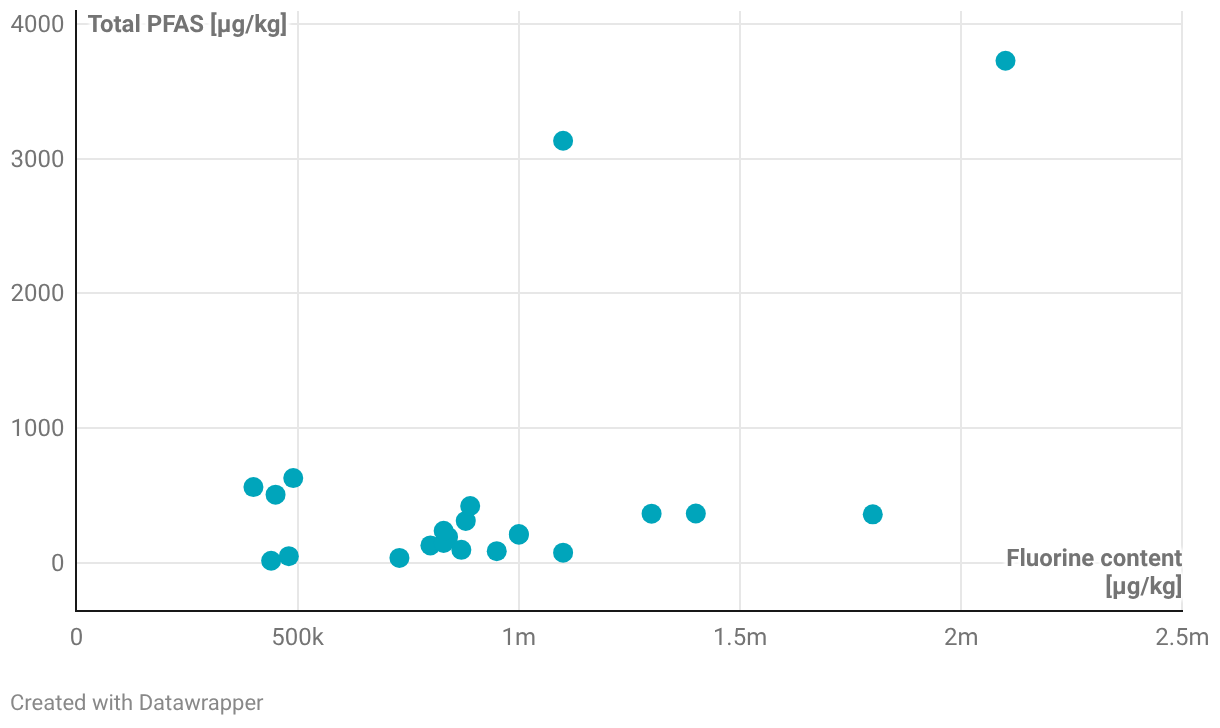
Since PFAS are fluorinated compounds, one might assume that fractions containing large amounts of PFAS also contain a lot of fluorine. Such a correlation would simplify the analysis, as it is much easier to determine the fluorine content than the levels of PFAS. This would significantly reduce laboratory costs compared to the complex PFAS analysis. Given that very low concentrations of PFAS were detected in the samples, it is not surprising that there is no correlation with the fluorine concentration in the samples (Figure 5). In some cases, fluorine concentrations are 500 times higher than PFAS concentrations. There must be other sources of fluorine in the samples that are not known.
Assessment of PFAS in the fractions
PFAS are always a problem when they enter the environment. They are so chemically stable that they can only be broken down to a limited extent by natural processes. The fractions produced during the recycling of WEEE by Swiss recyclers never end up directly in the environment. To ensure that PFAS are not released into the environment in an uncontrolled manner during subsequent processes such as incineration, landfill or further material recovery, it is essential to take appropriate measures. Furthermore, PFAS must not be carried over into new products in quantities exceeding the permitted limits. The concentrations in the fractions from the recycling of WEEE are generally low. The waste streams in which the highest PFAS concentrations were measured are either incinerated in hazardous waste or municipal waste incineration plants or recycled in metal smelting plants. Initial studies suggest that temperatures in these facilities are generally high enough to largely break down PFAS. However, our understanding of the mechanisms involved in various waste disposal processes is still limited5 6.
PFAS constitute a group of substances whose regulatory classification is currently under review. New guidelines and limit values, and their implications for permissible disposal methods, must be discussed among the relevant stakeholders. The Technical Audit Department contributes its expertise to support solutions that provide the best possible protection for health and the environment. At the same time, it should be borne in mind that the recycling of recyclable materials makes a significant contribution to the conservation of resources, and this should not be hindered by excessively strict limits. If PFAS are permitted in new products at concentrations far higher than those found in recycled materials, then, in our view, the objective of providing consistent protection for the environment and consumers will not be achieved.
Notes and Sources
- Rudin E, Aicher L, Heuberger M, Kroll A, Stamm C (2025). “PFAS: Vorkommen, Risiken und Handlungsansätze”. Swiss Academies Factsheets 20 (4)
- Meermann, B. et al. (2024). “Untersuchung des Vorkommens von PFAS (Per‑ und polyfluorierte Alkylverbindungen) in Abfallströmen – Abschlussbericht”. TEXTE 85/2024. German Environment Agency, Dessau‑Roßlau. Completion date: August 2023. ISSN 1862‑4804.
- VBSA (2025). «PFAS, Herausforderung für die Abfallbranche und die Kreislaufwirtschaft». https://vbsa.ch/artikel/pfas-herausforderungen-fur-die-abfallbranche-und-die-kreislaufwirtschaft (accessed on 03.03.2026).
- Glüge, J. et al. (2020). “An overview of the uses of per‑ and polyfluoroalkyl substances (PFAS)”. Environmental Science: Processes & Impacts, 22, 2345–2373. The Royal Society of Chemistry. DOI: 10.1039/d0em00291g.
- Gehrmann, H.-J. et al. (2024). “Mineralization of fluoropolymers from combustion in a pilot plant under representative European municipal and hazardous waste combustor conditions». https://doi.org/10.1016/j.chemosphere.2024.143403 (accessed on 03.03.2026).
- Urmann, K. et al. (2024). “PFAS in Abfallströmen – Literaturstudie im Auftrag des VBSA”. Econetta AG, Schlieren. https://www.datocms-assets.com/134367/1736952532-pfas-in-abfallstromen-literaturstudie-econetta-9-1-25.pdf (accessed on 14.04.2026).